
By a tattoo culture journalist who has tracked celebrity ink for over a decade
I remember the first time I really noticed Angelina Jolie’s back tattoos. It was 2008, the Cannes red carpet, and she turned to the side in a black strapless gown. The camera caught those sweeping lines of Khmer script cascading down her left shoulder blade, and I thought — that’s not decoration. That’s a diary written on skin.
Nearly two decades later, Jolie’s back remains one of the most discussed and analyzed canvases in tattoo history. And honestly, every time she steps out in something backless — which she did again at the Venice Film Festival just last September — the internet lights up with the same questions. What do they mean? When did she get them? Has anything changed?
I’ve spent years digging into the stories behind these tattoos, speaking with tattoo artists familiar with the styles she favors, and cross-referencing interviews she’s given over the years. This is the most comprehensive breakdown I can put together as of March 2026.
The Geography of Angelina Jolie’s Back
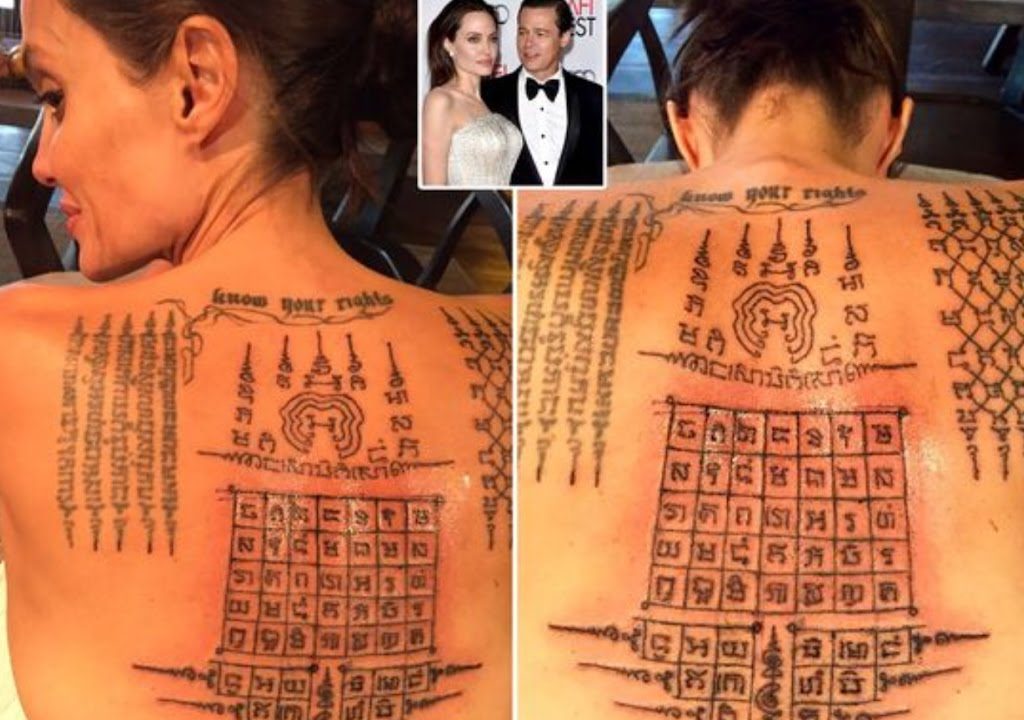
Before we dive into individual pieces, it helps to understand the layout. Jolie’s back isn’t covered in random tattoos — it’s a carefully curated collection that has evolved over roughly 25 years. The pieces span from her upper shoulders down to her lower back, and they fall into a few distinct zones:
- Upper back and shoulders: The Khmer (Cambodian) script and Yantra tattoos
- Center back: The Buddhist Pali incantation
- Lower center back: Geographic coordinates
- Upper right shoulder: A cross (now covered/modified)
Each zone tells a different chapter of her life. Let’s walk through them.
The Yantra Tattoos: Sacred Geometry from a Thai Master
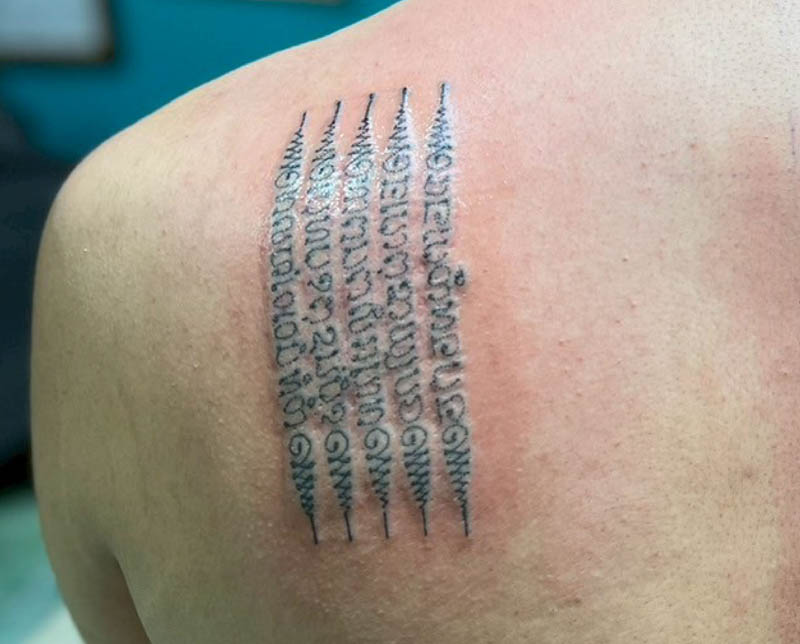
This is probably the most visually striking element on Jolie’s back, and it carries the deepest spiritual significance. The Yantra tattoos — sometimes called Sak Yant — are a form of sacred Thai tattooing that dates back centuries. These aren’t just designs. In the tradition of Theravada Buddhism, they’re believed to offer protection, luck, and spiritual power.
Jolie received her first Yantra tattoo in 2003 from Ajarn Noo Kanpai, a former monk and renowned Sak Yant master based in Thailand. The original piece sits on her upper left shoulder blade: five rows of ancient Khmer script. This is a traditional Sak Yant design known as Hah Taew (Five Lines), and each line carries a specific incantation:
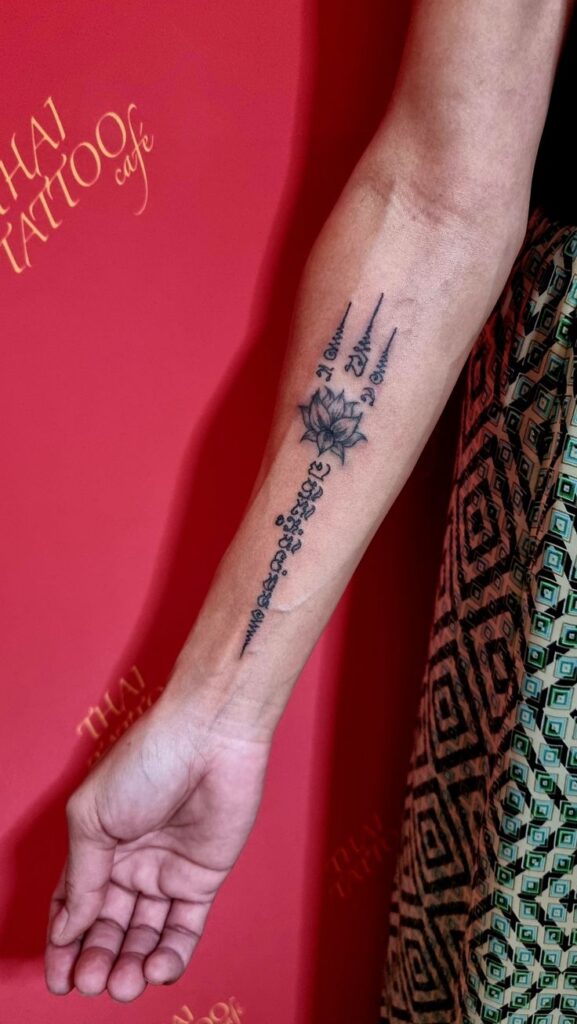
- Line one prevents unjust punishment and leans against evil
- Line two reverses bad fortune and negative energy
- Line three offers protection from black magic and curses
- Line four brings good luck, fortune, and success
- Line five boosts charisma and attraction
Ajarn Noo Kanpai used a traditional hand-poke method — a long metal rod tipped with a needle, no machine involved. The process is ritualistic. There’s chanting, there’s prayer, there’s a spiritual contract between the tattoo master and the recipient. It’s not something you walk into a studio and ask for on a whim.
What makes this more interesting is that Jolie went back. She returned to Ajarn Noo Kanpai multiple times over the years, reportedly adding more Yantra designs. By 2016, her back featured an expanded collection of Yantra work — three large columns of intricate geometric and script-based designs that flow from her shoulders toward the center of her back.
These additions were widely documented when she appeared at the premiere of First They Killed My Father in 2017. The tattoos were extensive, detailed, and clearly the result of multiple sessions. Some observers noted what appeared to be tiger Yantra elements and additional protective scripts.
As of early 2026, these Yantra tattoos remain the dominant visual feature of Jolie’s back. No modifications or cover-ups have been reported.
The Buddhist Pali Incantation
Running down the center of Jolie’s spine, there’s a prayer written in Pali — the liturgical language of Theravada Buddhism. This piece is distinct from the Yantra tattoos in both style and placement. It sits lower and follows the spine’s natural line.
The exact translation has never been fully confirmed by Jolie herself, but tattoo researchers and Pali scholars who have analyzed photographs believe it to be a protective prayer — specifically a version of a traditional Buddhist chant meant to shield the wearer and their family from harm.
Given Jolie’s deep connection to Southeast Asia — she became a Cambodian citizen, directed a film about the Khmer Rouge genocide, and has raised her son Maddox with strong ties to Cambodian culture — the choice of Pali script isn’t surprising. It’s a continuation of the same spiritual thread that runs through her Yantra work.
The Geographic Coordinates
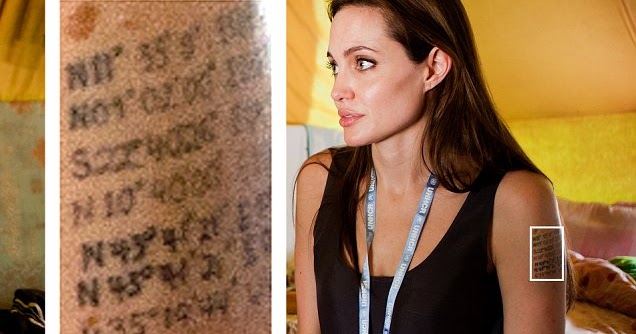
This is the one that gets the most attention from casual observers, partly because it’s the easiest to decode.
On her upper left arm, extending onto her shoulder and back area, Jolie has a series of geographic coordinates — latitude and longitude — each representing the birthplace of one of her children. Originally, she had coordinates for her first adopted son, Maddox (born in Cambodia). Over time, she added coordinates for:
- Zahara — born in Ethiopia
- Shiloh — born in Namibia
- Pax — born in Vietnam
- Knox and Vivienne — born in Nice, France
She also had a coordinate for Brad Pitt’s birthplace (Shawnee, Oklahoma), which has been a subject of much speculation post-divorce. As of the most recent clear photos from late 2025, the coordinate for Pitt’s birthplace appears to still be present, though some eagle-eyed fans have suggested it may have been subtly altered or integrated into surrounding design work. Neither Jolie nor her representatives have commented on this.
The coordinates replaced a previous tattoo — a small dragon — and were originally done with the geographic cross symbol. The style is clean, precise, almost clinical in its simplicity, which creates an interesting contrast with the organic, flowing Yantra work nearby.
The Cross and the Dragon: What Came Before
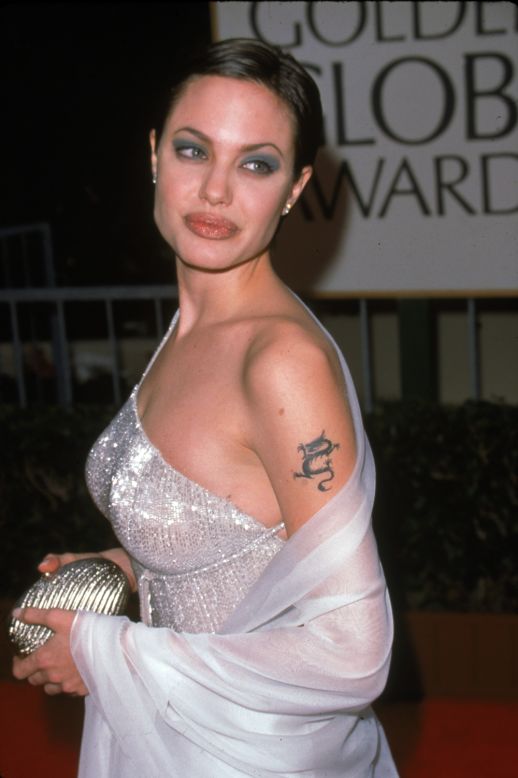
Jolie’s back hasn’t always looked the way it does now. In the late 1990s and early 2000s, she had a small black cross on her lower back/hip area and a small blue-black dragon on her left upper back area.
The dragon was covered by the geographic coordinates. The cross has been incorporated into or obscured by later work. These early tattoos reflected a younger Jolie — less spiritually focused, more impulsive by her own admission. In a 2010 interview, she acknowledged that her early tattoos were somewhat reactive, done during turbulent personal periods, while her later ones were deliberate and meaningful.
This evolution is actually one of the most relatable things about Jolie’s tattoo journey. Most people who get tattooed over decades go through a similar arc — early pieces that feel right in the moment, followed by more considered work that reflects who you’ve actually become.
The “Prayer for the Wild at Heart” — Upper Back
A lesser-discussed piece is the text tattoo quoting Tennessee Williams: “A prayer for the wild at heart kept in cages.” This was one of Jolie’s earlier tattoos, placed on her left upper back/shoulder area. It predates most of her Yantra work and has been partially incorporated into the larger back design over time.
The quote is from Williams’ play Stairs to the Roof, and Jolie has mentioned in past interviews that it resonated with her during a period when she felt confined by expectations — both personal and professional. As someone who was navigating Hollywood fame while dealing with genuine mental health struggles in her twenties, the sentiment makes complete sense.
How the Back Tattoos Have Changed Over Time: A Timeline
| Year | Addition/Change |
|---|---|
| ~1997-2000 | Small cross, dragon, Tennessee Williams quote |
| 2003 | First Yantra (Hah Taew) by Ajarn Noo Kanpai |
| 2004-2006 | Geographic coordinates begin (Maddox, then others) |
| 2008-2011 | Additional coordinates added; dragon covered |
| 2016 | Major Yantra expansion — three columns of sacred script |
| 2017-2019 | Possible additional fine-line work connecting existing pieces |
| 2020-2025 | No confirmed new additions; existing work maintained |
| 2026 (current) | Back tattoos appear fully intact in recent appearances |
The Cultural Significance — and the Criticism
Jolie’s Sak Yant tattoos have sparked occasional criticism around cultural appropriation. Some argue that a wealthy white Hollywood actress getting sacred Thai-Cambodian tattoos is inherently problematic, regardless of intent.
I think this deserves honest engagement rather than dismissal. The criticism isn’t baseless — sacred tattoo traditions do carry spiritual weight within their originating cultures, and when they become trendy among Western celebrities, the meaning can get diluted.
However, Jolie’s case is more nuanced than most. She didn’t get a Sak Yant because she saw one on Instagram. Her connection to Cambodia spans decades — she holds Cambodian citizenship, has invested significantly in the country, directed a major film centering Cambodian history, and raised a Cambodian-born son with active ties to the culture. Her Yantra tattoos were done by a recognized master using traditional methods and rituals.
Does that make it entirely unproblematic? Reasonable people disagree. But it’s a far cry from someone walking into a tattoo parlor in Brooklyn and pointing at a flash design they think looks cool.
What Her Tattoos Tell Us About Tattoo Culture in 2026
Looking at Jolie’s back in 2026, what strikes me most is how ahead of the curve she was. The trends we’re seeing now — meaningful, story-driven tattoos, sacred and spiritual ink, hand-poke and traditional methods, full-body narratives that evolve over years — Jolie was doing this twenty years ago.
The tattoo industry has moved decisively away from the “random sleeve” aesthetic toward an intentional, biographical approach. Her back is essentially a spiritual autobiography, and that’s become the gold standard for what many people want from their tattoos today.
Where to See the Best Photos
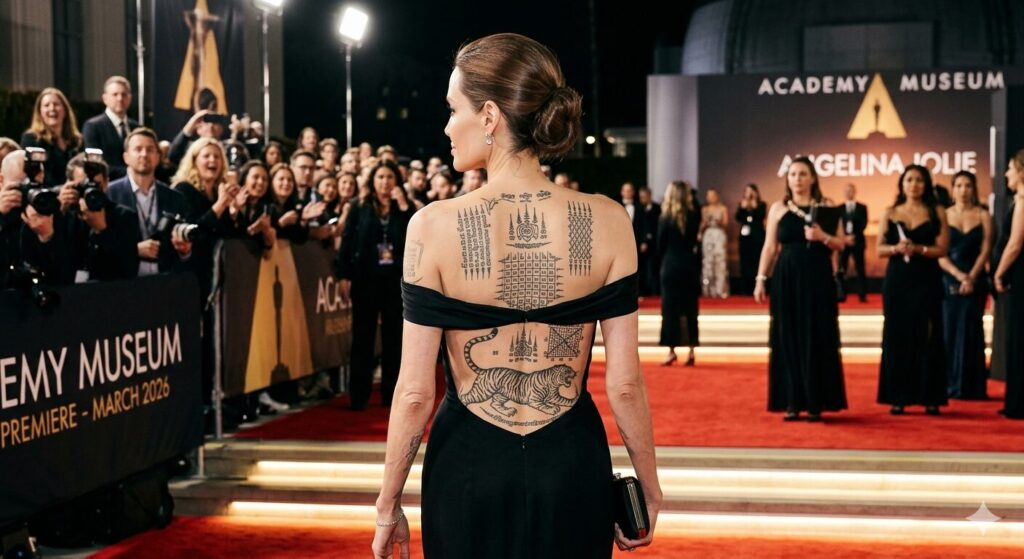
For the clearest views of Jolie’s back tattoos, look for photos from:
- 2017 Cambodia premiere of First They Killed My Father (most comprehensive view of the Yantra work)
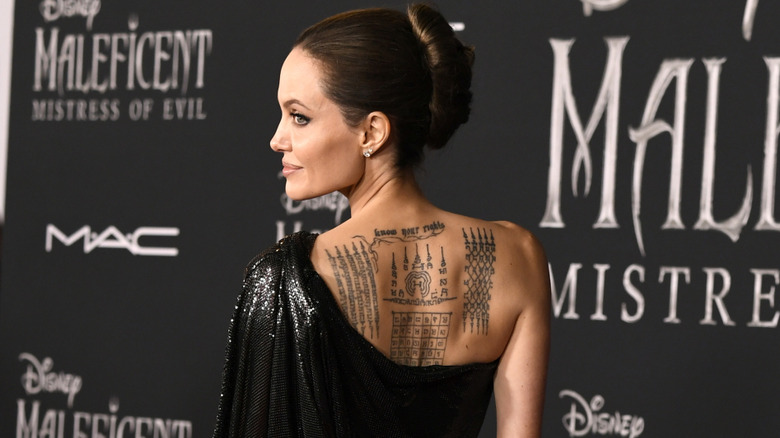
- 2019 Maleficent premiere (good rear angle in a backless gown)
- 2024 Venice Film Festival (Maria premiere — striking black gown with visible upper back)
- 2025 red carpet appearances (multiple events with partial back exposure)
Professional photographer agencies like Getty Images and WireImage have the highest-resolution versions. Fan archives on dedicated Jolie sites also compile these, though image quality varies.
Frequently Asked Questions
How many tattoos does Angelina Jolie have on her back?
Depending on how you count interconnected pieces, Jolie has approximately 5-7 distinct tattoo elements on her back, including Yantra sacred script, geographic coordinates, a Buddhist Pali incantation, the Tennessee Williams quote, and remnants or modifications of earlier pieces like a cross and dragon.
Who did Angelina Jolie’s back tattoos?
The Sak Yant (Yantra) tattoos were done by Thai tattoo master Ajarn Noo Kanpai using traditional hand-poke methods. Her other back tattoos have been done by various tattoo artists over the years, though specific artists for every piece haven’t been publicly confirmed.
What language are Angelina Jolie’s back tattoos written in?
The primary scripts are ancient Khmer (used in the Yantra/Sak Yant designs) and Pali (the Buddhist prayer along her spine). The geographic coordinates are in standard numerical notation.
Did Angelina Jolie remove any back tattoos?
She has not removed any back tattoos via laser, but she has covered earlier pieces — notably a small dragon that was replaced by the geographic coordinates. She famously had a “Billy Bob” tattoo on her upper arm (not back) removed after her divorce from Billy Bob Thornton.
Are Angelina Jolie’s Sak Yant tattoos real traditional ones?
Yes. They were performed by a recognized Sak Yant master using traditional tools and accompanying Buddhist rituals, not by a conventional tattoo machine. This is significant within the tradition, as the ritual component is considered essential to the tattoo’s spiritual power.
Has Angelina Jolie gotten any new back tattoos in 2025 or 2026?
As of March 2026, no new back tattoos have been confirmed. Her most recent major additions appear to have been the expanded Yantra work documented around 2016. Her existing back tattoos remain visible and well-maintained in recent public appearances.
What do the coordinates on Angelina Jolie’s back represent?
Each set of coordinates marks the birthplace of one of her six children, plus one set reportedly representing Brad Pitt’s birthplace in Oklahoma. The coordinates for her children include locations in Cambodia, Ethiopia, Namibia, Vietnam, and France.
Final Thoughts
I’ve been writing about tattoo culture for a long time, and what I keep coming back to with Jolie’s back is this: it’s honest. It’s not curated for aesthetic perfection. It’s not trendy. Some pieces are over 20 years old and sit next to work done a decade later, and the styles don’t always match. There are covered-up pieces and faded edges.
That’s what a real tattoo collection looks like when it spans a lifetime of growth, loss, motherhood, spiritual seeking, and reinvention. In an era where tattoo culture sometimes feels dominated by Instagram-perfect flash and influencer aesthetics, Jolie’s back remains a reminder that the best tattoos aren’t the prettiest ones — they’re the truest ones.