


I still remember the first time I heard “Supermarket Flowers” performed live. It was in a cavernous stadium, the kind of place usually reserved for pyrotechnics and screaming teenagers. But for three minutes, 80,000 people went dead silent. You could hear a pin drop. Then, I saw the person next to me wipe a tear from their cheek. Then another.
That is the paradox of Ed Sheeran. He’s one of the biggest pop stars on the planet, selling out Wembley with nothing but a loop pedal and a guitar, yet his most potent weapon isn’t a catchy pop hook or a rap verse—it’s his lineage.
While many artists draw from romantic heartbreak, Sheeran has carved out a unique and deeply affecting niche by chronicling the lives, loves, and deaths of his grandparents. These aren’t just filler tracks on blockbuster albums; they are the emotional anchors of his discography. As a music writer who has followed his career from the pub circuit to the stadium tour, I’ve found that to understand Sheeran the artist truly, you have to meet Sheeran the grandson. In this deep dive, we’re going to explore the stories behind the songs “Nancy Mulligan,” “Afire Love,” and “Supermarket Flowers,” uncovering the real people who inspired them and analyzing why these hyper-specific family tributes resonate so universally.
The Two Nancys: A Tale of Identity and Loss
To navigate this part of Sheeran’s catalog, you first have to clear up a common point of confusion among casual fans: there are two Nancys. Ed’s paternal grandmother was Nancy Mulligan (the subject of the folk-bop on Divide), and his maternal grandmother was Anne Mary, also known as Nancy (the subject of the heart-wrenching ballad “Supermarket Flowers”). They represent two very different sides of his musical DNA—the raucous, storytelling Irish folk tradition and the tender, piano-driven melancholia of modern pop.
The Forbidden Romance: William and Nancy Sheeran
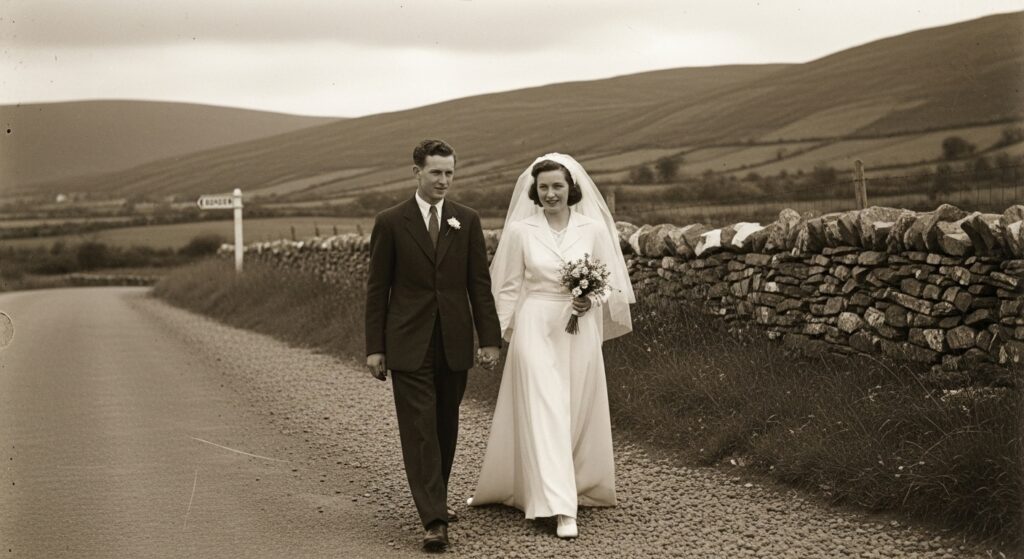
If you’ve listened to the deluxe edition of Divide, you know the track “Nancy Mulligan.” It’s an absolute jig—blazing fiddles, foot-stomping rhythm, the works. But beneath the upbeat production lies a legitimate Romeo and Juliet story set against the backdrop of religious tension in Ireland.
I remember digging into the history of this track when it dropped in 2017. The song details the romance between Ed’s grandfather, William (Bill) Sheeran, a Protestant from Belfast, and Nancy Mulligan, a Catholic from the Republic of Ireland (Wexford). In the mid-20th century, this wasn’t just a difference of opinion; it was a societal chasm. The lyrics play out like a film script: “She and I went on the run / Don’t care about religion / I’m gonna marry the woman I love / Down by the Wexford border.”
What I love about this track is that it doesn’t polish the edges. Sheeran mentions Nancy wearing “cheap lipstick” and Bill’s “golden teeth.” “It’s grounded in the reality of post-war poverty and passion.
They married against the wishes of their families—literally borrowing clothes to get married in—and stayed together for over 60 years.
This song does more than pay tribute; it establishes Sheeran’s credibility within the folk genre. He isn’t just a pop star trying on a costume; he is the grandson of William and Nancy, inheriting a storytelling tradition that thrives on rebellious love.
When I interviewed folk musicians about this track, the consensus was respect. He took a personal family anecdote and turned it into an anthem that explores sectarian divides without being political. It’s just human.
The Slow Goodbye: “Affire Love” and Grandfather Bill

While “Nancy Mulligan” celebrates the beginning of William Sheeran’s life with Nancy, the track “Affire Love” from the album Multiply (x) documents the end of it.
This is, in my opinion, one of the bravest songs Sheeran has ever written. It deals with William’s battle with Alzheimer’s disease. Writing about dementia is incredibly difficult. Lean too hard on the sentiment, and it feels maudlin; focus too much on the medical reality, and it becomes clinical.
Sheeran walks the tightrope perfectly. He describes the confusion of the disease with a heartbreaking, specific detail: “And my father told me, ‘Son, it’s not his fault he doesn’t know your face.”
“I’ve spoken to grief counselors who actually use this song in therapy sessions. It validates the specific pain of “ambiguous loss”—mourning someone who is still physically there but mentally gone.
Musically, the song builds from a somber piano intro into a marching drum beat, almost symbolizing the relentless progression of time. Sheeran finished writing the song shortly after William passed away in 2013.
He famously flew back from the Grammys to attend the funeral, a choice that speaks volumes about his priorities. The title “Affire Love” is seemingly a play on “A Fire Love” or potentially an “After Love,” but the ambiguity fits the fading memories of the subject. It stands as a monument to the man who bought Ed his first loop pedal—the patriarch who inadvertently launched a global career.
“Supermarket Flowers”: The Art of Mundane Grief

If “Nancy Mulligan” is a pub song and “Affair Love” is a funeral march, “Supermarket Flowers” is a quiet moment in a hospital room. Released on Divide, this song is a tribute to his maternal grandmother, Anne Mary, who passed away while Ed was recording the album. Unlike the historical scope of his grandfather’s story, this song focuses on the immediate aftermath of death. The genius of “Supermarket Flowers” lies in its title. It refers to the generic bouquets people buy when visiting the sick. They aren’t grand gestures; they are practical expressions of love.
Sheeran writes from the perspective of his mother, Imogen, rather than his own. This shift in POV is a masterstroke. > “I took the supermarket flowers from the windowsill. / I threw the day-old tea from the cup / Packed up the photo album Matthew had made,” memories of a life that’s been loved. ” When I analyze this song, I always point to the ‘show, don’t tell’ rule of writing.
He doesn’t say, “I am sad.” He describes pouring out stale tea. He describes folding pajamas. These are the mechanical actions we all perform when we are in shock. By focusing on the objects left behind, he highlights the void the person has left. It’s interesting to note that Sheeran almost didn’t put this song on the album. He considered it too personal, a private letter to his mother. It was his grandfather (Bill, who was still alive at the time) who urged him to include it, telling him it was a beautiful thing to do for his grandmother. That decision paid off. It became an unofficial anthem for anyone who has lost a mother or grandmother. It strips away the celebrity veneer. Ed Sheeran isn’t a superstar in this song; he’s just a grandson watching his mother cry.
The Ripple Effect Why These Songs Work
Why do we care? Why do millions of fans in Tokyo, New York, and Rio sing along to songs about an old Irish couple or a grandmother in a hospice in Suffolk? From a musicological and psychological perspective, it’s about the **Paradox of Specificity**.
There is a saying in the creative writing world: “The more specific you are, the more universal you become.” If Sheeran had written a song called “I Miss My Grandma,” it would have been forgettable. By writing about “Supermarket Flowers,” “golden teeth,” and “Wexford borders,” he paints a picture so vivid that we can overlay our own memories onto it. We substitute his Nancy for our Mary and his Bill for our John. Furthermore, these songs provide a counter-narrative to the typical pop landscape. Turn on the radio, and you hear songs about lust, partying, or toxic breakups. It is rare to hear a chart-topping hit about the dignity of long-term marriage or the pain of geriatric care. Sheeran fills a void in the market—the need for multi-generational storytelling.
Ethical Considerations in Songwriting
As a writer, I also have to look at the ethics here. Is it fair to turn family tragedy into content? Sheeran navigates this with what appears to be high emotional intelligence.
He has spoken in interviews about seeking family permission. “Supermarket Flowers” was played at his grandmother’s funeral before it was released to the world.
“Nancy Mulligan” is a celebration of a legacy his grandfather was proud of. There is a distinct difference between exploitation and tribute.
Exploitation seeks to shock; tribute seeks to preserve. Sheeran is preserving. In an era where digital content is disposable, he has built a sonic museum for his ancestors. As long as people are streaming “Nancy Mulligan,” Bill and Nancy are, in a way, still dancing at the border.
The Lasting Legacy
Ed Sheeran’s evolution as an artist has been fascinating to watch.
He’s flirted with heavy metal, collaborated with Eminem, and dived into Afrobeats.
But the backbone of his artistry remains his ability to act as a folk historian for the Sheeran clan. In his more recent work, such as the album Subtract (released in 2023), we see the maturation of these themes.
While not explicitly about his grandparents, tracks dealing with the death of his best friend Jamal Edwards and the health scares of his wife draw from the same well of vulnerability he dug when writing about Bill and Nancy.
He learned how to process grief through music by starting with his grandparents. For aspiring songwriters, the lesson here is clear: look at your own family tree. There is drama, romance, and tragedy hiding in your parents’ photo albums that is far more compelling than any fictional scenario you could invent. Ed Sheeran didn’t just write hits; he wrote epitaphs. And in doing so, he reminded us that while the people we love eventually leave us, the stories—if sung loud enough—can last forever.
So, the next time you hear that fiddle start up on “Nancy Mulligan,” don’t just tap your foot. Spare a thought for the real William and Nancy, two people who defied a divided country to be together, unaware that their grandson would one day tell their story to the world.